SEO
Jul 17, 2026
Best SEO Tools in 2026: An Authority-Based Meta-Analysis

Alex Fanshel
CEO, New Standard Digital

The Best SEO Tools in 2026
An Authority-Weighted Meta-Analysis of 80+ Expert Rankings
Last updated: June 2026. Author: New Standard Digital (technical SEO, content, and Amazon agency, New York City). Methodology: aggregated 80+ published rankings, weighted by the Domain Rating of each source, with pricing and user ratings verified per tool.
Key takeaways
The best overall SEO tool in 2026 is Semrush, the most-cited platform across high-authority rankings, with Ahrefs a close and equally defensible co-leader.
Four tools form the consensus core of almost every serious stack: Semrush, Ahrefs, Google Search Console, and Screaming Frog.
When rankings are weighted by Domain Rating, the established names get stronger, not weaker. Many newer tools fall because their top billing comes from low-authority or vendor-owned blogs.
On user ratings the content tools score highest (Clearscope 4.9/5, Surfer 4.8/5 on G2), while the big suites sit at a still-strong 4.3 to 4.5 across far larger review counts.
Entry prices run from free (Google Search Console, GA4) to $229/mo (AccuRanker); most professional suites land between $39 and $140.
No single tool wins every job. The most effective setups combine three to four specialist tools rather than stretching one platform thin.
This analysis by the numbers
Metric | Figure |
|---|---|
Ranking lists reviewed | 80+ |
SEO sub-disciplines covered | 9 |
Source domains sampled for Domain Rating | 30 |
Average Domain Rating of sampled sources | ~69 |
Median Domain Rating of sampled sources | ~73 |
Tools reviewed in depth | 20 |
Lowest / highest entry price | $0 / $229 per month |
Highest user rating | 4.9/5 (Clearscope, G2) |
Roughly one third of the sources we reviewed sit at DR 90 or above, which is why authority weighting meaningfully changes the result. The distribution of source authority is shown below.
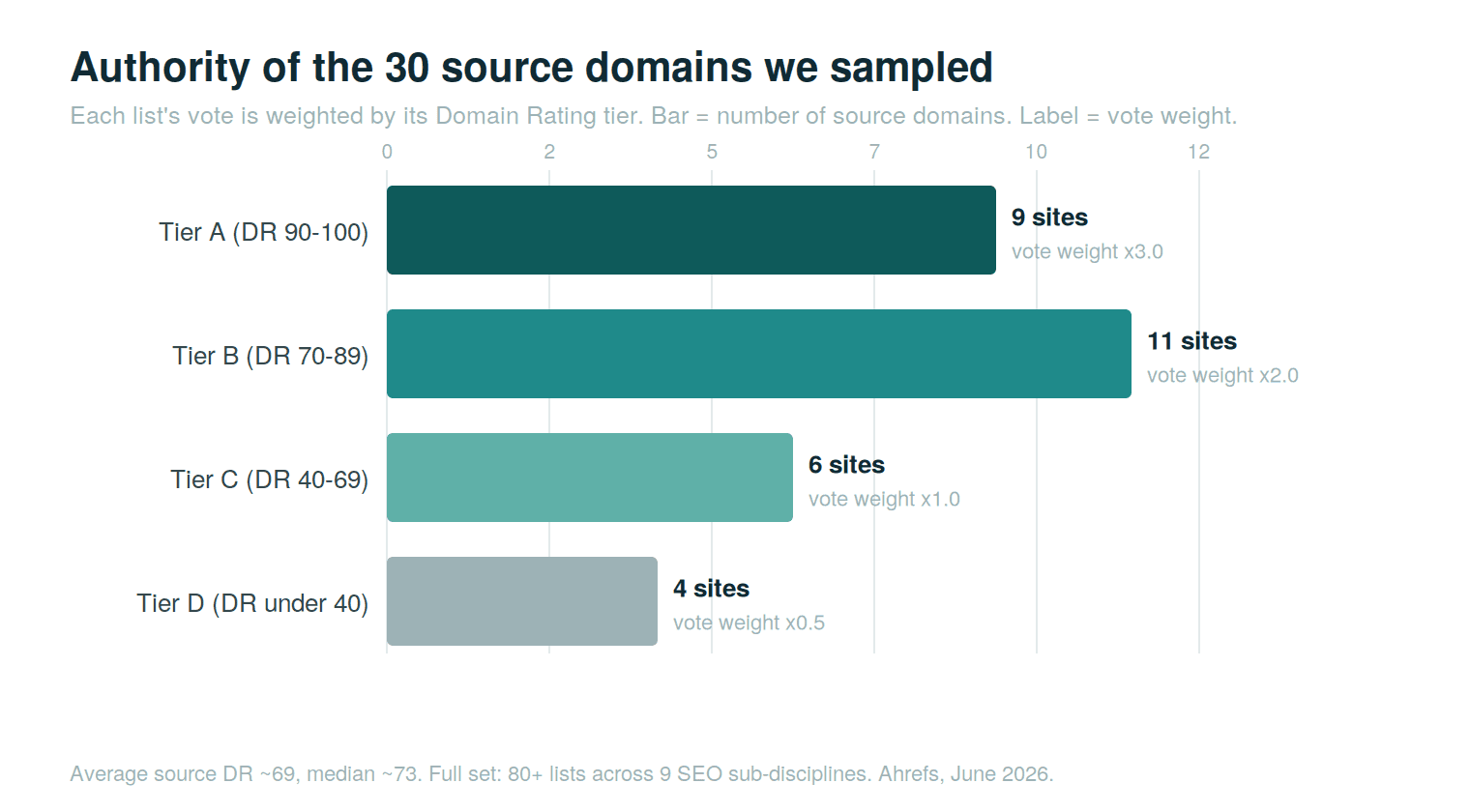
Authority of the 30 source domains, grouped into DR tiers A to D
What are the best SEO tools in 2026?
The best SEO tools in 2026 are Semrush and Ahrefs for all-in-one work, Google Search Console for free first-party data, and Screaming Frog for technical audits. These four appear in nearly every expert ranking we reviewed and form the backbone of most professional SEO stacks. Specialist tools then win individual jobs: Surfer and Clearscope for content, AccuRanker for rank tracking, BrightLocal for local, and Profound for AI visibility.
How was this ranking built, and why weight by Domain Rating?
This ranking aggregates more than 80 published “best SEO tools” lists from mid-2025 through mid-2026, then weights each list’s vote by the Domain Rating (DR) of the site that published it. Weighting by authority matters because a recommendation from a DR 91 outlet that thousands of sites link to carries more signal than the same recommendation on a brand-new vendor blog that exists to sell its own tool.
We scored every tool on four weighted inputs:
Authority-weighted appearances. Each mention counts, multiplied by the publishing domain’s DR tier.
Category leadership. Extra weight for being ranked first or “best for X” in its category.
Data accuracy and depth. Whether independent testers found the data reliable, for example organic traffic estimates cross-checked against Google Analytics 4.
Review and practitioner sentiment. G2 and Capterra ratings, Reddit consensus, and repeat appearances across independent reviewers.
The Domain Rating tiers behind the weighting
We pulled live Domain Ratings (Ahrefs, June 2026) for a representative sample of the source domains. The spread below shows why authority weighting changes the outcome.
Tier | DR range | Weight | Example source domains (DR) |
|---|---|---|---|
A | 90–100 | ×3.0 | HubSpot (93), Semrush (92), TechRadar (91), Zapier (91), G2 (91), Backlinko (90) |
B | 70–89 | ×2.0 | SE Ranking (85), TechnologyAdvice (79), Neal Schaffer (77), Search Atlas (76), Nightwatch (72) |
C | 40–69 | ×1.0 | Marketer Milk (67), Evertune (57), AI SEO Tracker (50), T-Ranks (46) |
D | under 40 | ×0.5 | Topical Map (36), Geoptie (35), Orange Monke (27), Sanbi (8) |
The pattern is the point: high-DR sources overwhelmingly anchor on a small set of established tools, while newer tools earn their top rankings mainly on DR sub-40 domains or their own websites. Authority weighting corrects for that.
On honesty: the Meta Scores below are our weighted synthesis, not a vendor benchmark. Pricing and ratings move constantly, so treat every figure as indicative and confirm on the vendor’s site. No vendor paid for placement.
The authority-weighted ranking
The two shaded rows are the outright category-definers. “Movement” shows what happens when you switch from counting raw mentions to weighting each list by its authority: Up (strong domains back it), Down (support came from weak or self-published sites), or Hold.
# | Tool | Best at | Score | Move | Entry price | Rating |
|---|---|---|---|---|---|---|
01 | Semrush | All-in-one platform | 98 | Hold | $139.95/mo | 4.5/5 |
02 | Ahrefs | Backlinks, accuracy | 97 | Hold | $129/mo | 4.5/5 |
03 | Google Search Console | Free first-party data | 95 | Hold | Free | — |
04 | Screaming Frog | Technical crawling | 91 | Hold | Free / $259/yr | 4.7/5 |
05 | Moz Pro / Local | Keyword Explorer, local | 83 | Up | $39/mo | 4.3/5 |
06 | Google Analytics 4 | Traffic & conversions | 82 | Up | Free | — |
07 | SE Ranking | Best value all-in-one | 80 | Hold | $52/mo | 4.7/5 |
08 | Surfer SEO | Content optimization | 78 | Hold | $79/mo | 4.8/5 |
09 | Clearscope | Premium content | 75 | Hold | $129/mo | 4.9/5 |
10 | Yoast / Rank Math | WordPress on-page | 72 | Up | Free / ~$99/yr | High |
11 | AccuRanker | Speed rank tracking | 69 | Hold | $229/mo | 4.8/5 |
12 | Mangools | Budget research | 66 | Up | $29.90/mo | 4.9/5* |
13 | Sitebulb | Audit prioritization | 63 | Hold | ~$35/mo | 4.5/5 |
14 | Majestic | Link intelligence | 60 | Hold | ~$50/mo | — |
15 | Ubersuggest | Beginner research | 58 | Hold | $29/mo | Mixed |
16 | BrightLocal | Local SEO suite | 56 | Down | $39/mo | 4.6/5 |
17 | Frase | Budget AI content | 54 | Hold | $15–45/mo | 4.8/5 |
18 | Nightwatch | Local rank tracking | 50 | Down | ~$39/mo | 4.8/5 |
19 | Search Atlas | All-in-one + execution | 48 | Down | ~$99/mo | Mixed |
20 | Profound | Enterprise AI visibility | 46 | Hold | $30k+/yr | Leader |
Why some tools moved. Moz, the Google free tools, and Yoast or Rank Math rose because they dominate the DR 90+ lists (Zapier, Buffer, HubSpot, Backlinko, G2). Search Atlas and Nightwatch fell because much of their top billing comes from their own domains and mid-tier blogs. The GEO startups that rank first on their own DR sub-40 sites score low once authority is applied. *Mangools rating is from Capterra.
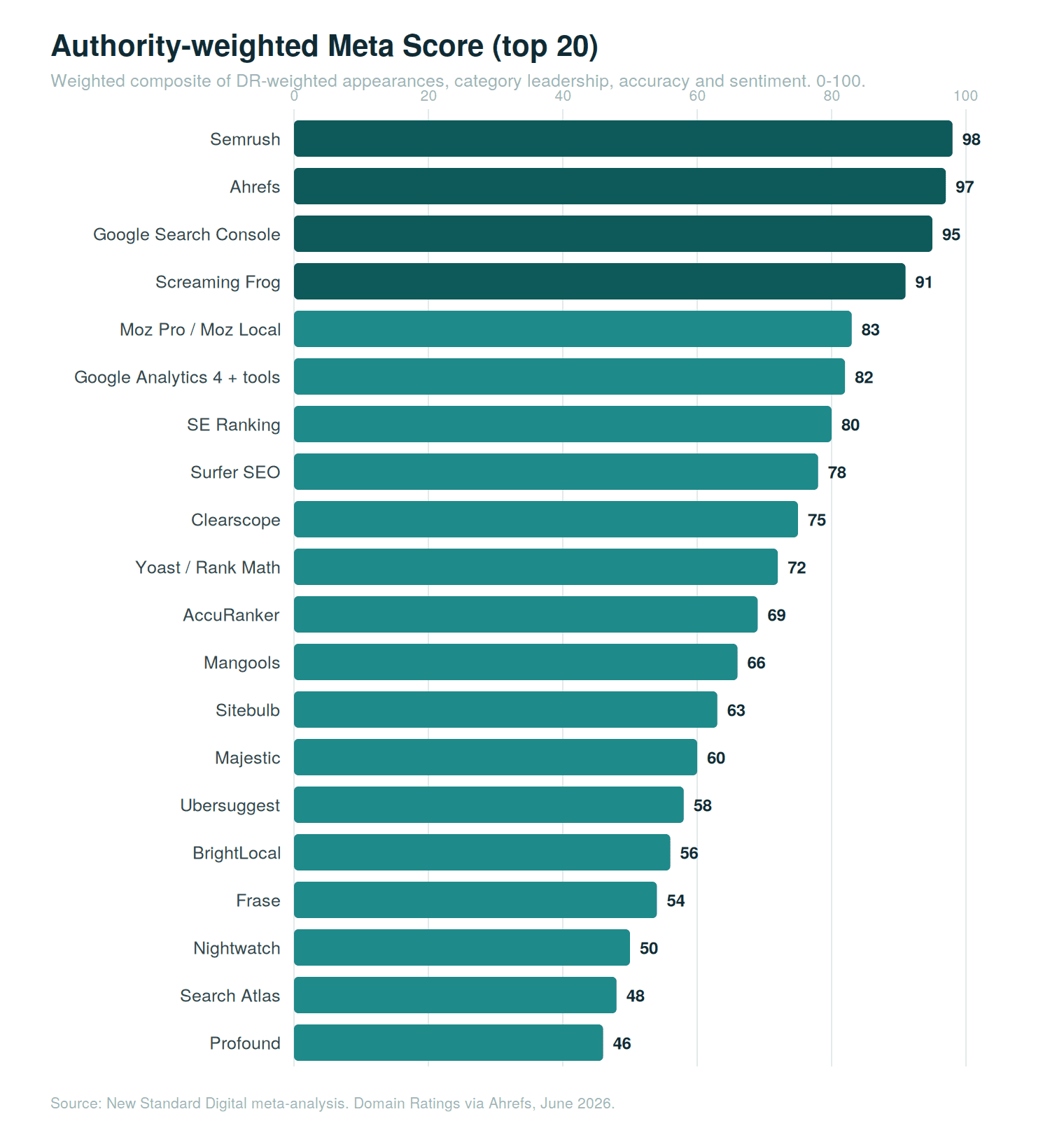
Authority-weighted Meta Score for the top 20 tools
How much do the best SEO tools cost?
Entry prices span from free to $229 per month. Google Search Console and GA4 cost nothing, the WordPress plugins and budget keyword tools sit under $30, the mainstream suites cluster between $39 and $140, and dedicated enterprise trackers run higher. Profound, an enterprise AI visibility platform at $30,000+ per year, is excluded from the chart to keep the scale readable.
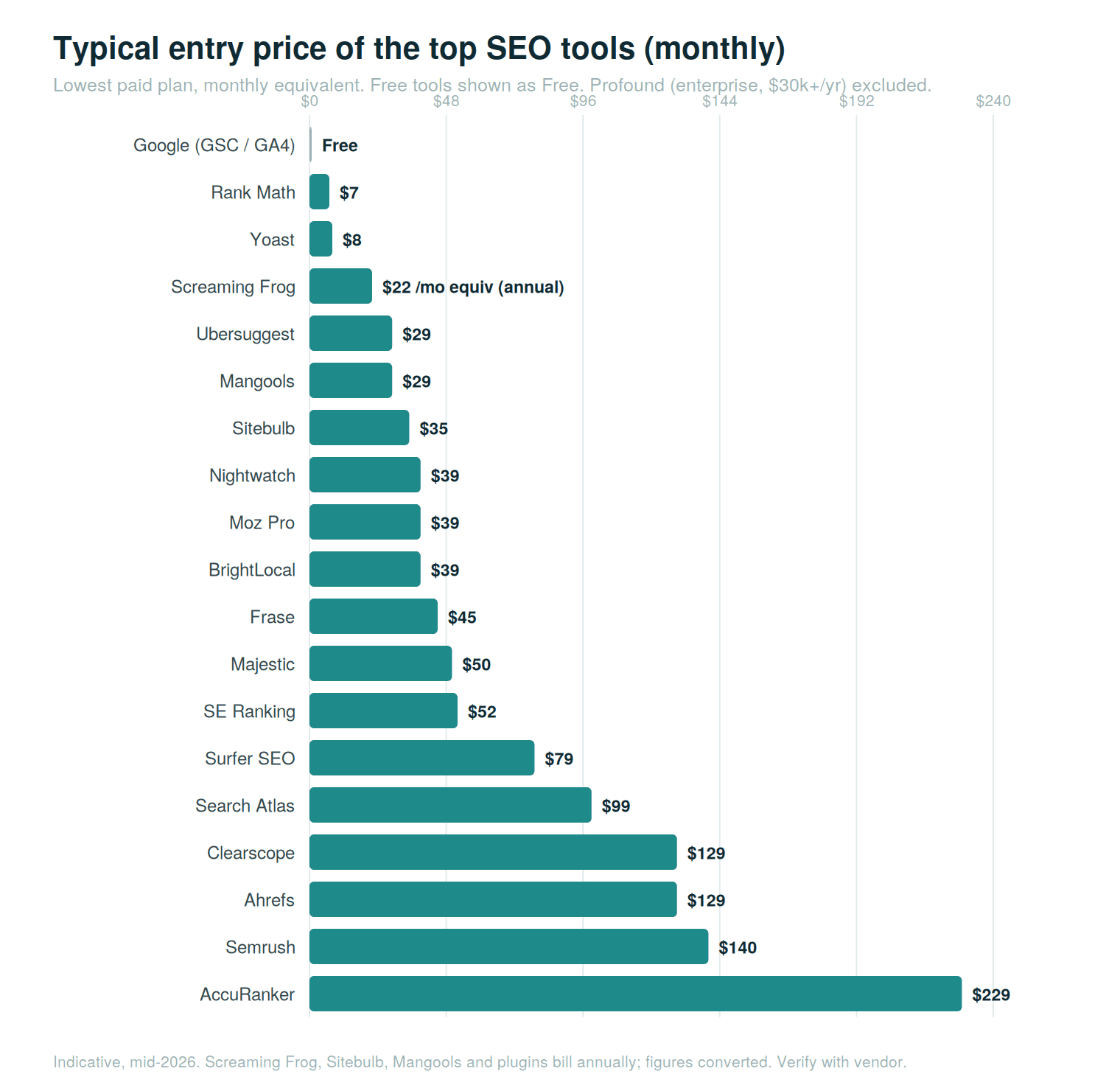
Typical entry price of the top SEO tools (monthly equivalent)
How are the top tools rated by users?
Ratings are strong across the board but split by type. Dedicated content tools score highest (Clearscope 4.9, Surfer 4.8) because they do one job well. The all-in-one suites sit at 4.3 to 4.5 across far larger review counts. One nuance worth knowing: Ahrefs holds 4.5/5 on G2 yet 2.0/5 on Trustpilot from 306 reviews, a gap driven almost entirely by billing complaints rather than product quality.
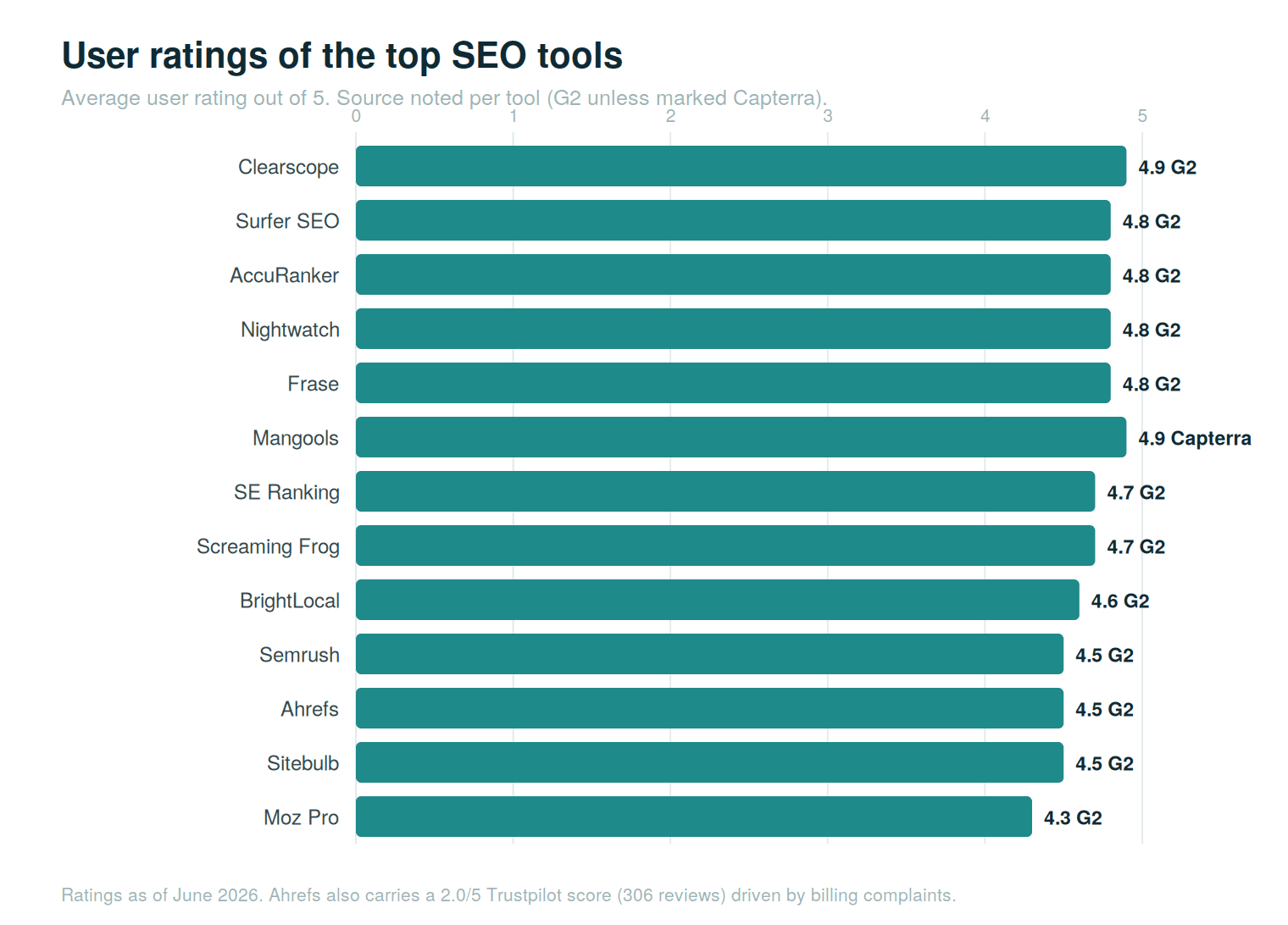
Average user rating out of 5 (G2 unless marked Capterra)
How much authority do the tools themselves have?
A tool that preaches SEO should rank in SEO, and the strongest names do. We pulled the live Domain Rating of each tool’s own marketing site. Google leads at DR 99, the established suites cluster in the high 80s and low 90s, and the newest entrants sit lower. The tools with the most authoritative own-sites are, with few exceptions, the same ones that top the ranking.
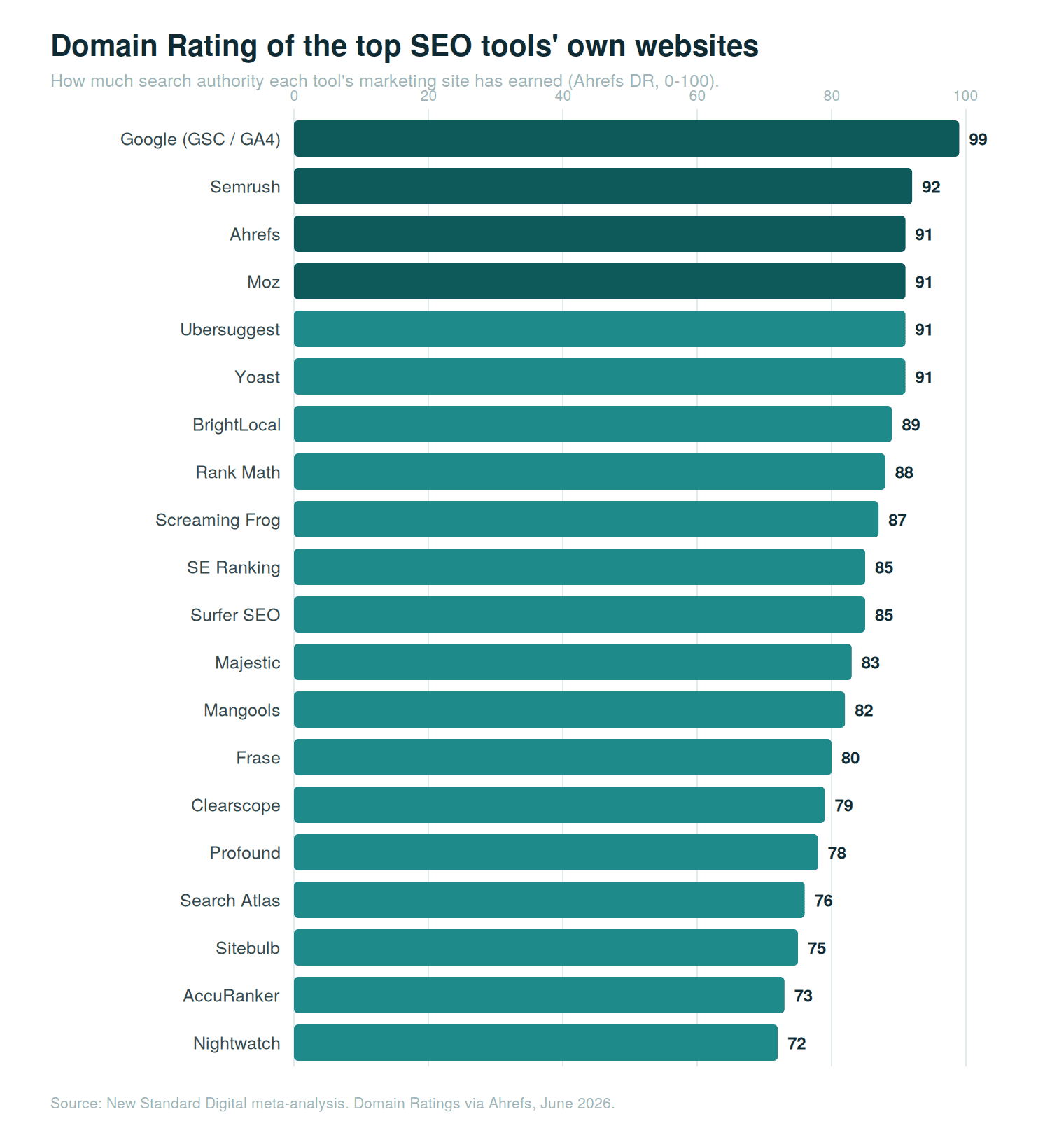
Domain Rating of each top tool’s own website (Ahrefs, June 2026)
Tool | Website Domain Rating |
|---|---|
Google (Search Console, GA4, Keyword Planner) | 99 |
Semrush | 92 |
Ahrefs | 91 |
Moz | 91 |
Ubersuggest (Neil Patel) | 91 |
Yoast | 91 |
BrightLocal | 89 |
Rank Math | 88 |
Screaming Frog | 87 |
SE Ranking | 85 |
Surfer SEO | 85 |
Majestic | 83 |
Mangools | 82 |
Frase | 80 |
Clearscope | 79 |
Profound | 78 |
Search Atlas | 76 |
Sitebulb | 75 |
AccuRanker | 73 |
Nightwatch | 72 |
The best SEO tool in every category
Category | Best overall | Runner-up | Best value / free |
|---|---|---|---|
All-in-one platform | Semrush | Ahrefs | SE Ranking |
Keyword research | Semrush | Ahrefs | Google Keyword Planner |
Backlink analysis | Ahrefs | Semrush | Ahrefs free checker |
Technical SEO / audits | Screaming Frog | Sitebulb | Google Search Console |
Rank tracking | AccuRanker | Semrush | SE Ranking |
Content optimization | Surfer SEO | Clearscope | Frase |
Local SEO | BrightLocal | Whitespark | Google Business Profile |
AI visibility / GEO | Profound | Peec AI | Semrush AI Toolkit / Brand Radar |
WordPress plugin | Yoast SEO | Rank Math | Both free to start |
In-depth reviews of the top 20
Every tool below carries its real entry price and verified user rating (G2 unless noted), a one-line “best for,” and the honest pros and cons that came up repeatedly across independent reviews.
01. Semrush
Semrush is the best all-in-one SEO platform in 2026 and the most-cited tool across the rankings we reviewed.
Best for: Agencies and in-house teams that want one platform for everything.
Pricing: Pro $139.95/mo (~$117.33 annual), Guru $249.95/mo, Business $499.95/mo. 7-day trial.
User rating: 4.5/5 on G2 (thousands of reviews).
Pros
The widest toolset on the market (55+ tools)
Deep data, 27B+ keywords
Integrated content and PPC workflows
Fast-improving AI visibility tracking
Cons
Expensive once you add seats
Steep learning curve, sprawling interface
Keyword difficulty scores can overstate competition
Traffic estimates don’t always match Search Console
02. Ahrefs
Ahrefs is the best tool for backlink analysis and the co-leader for all-in-one work.
Best for: Link-led SEO teams and anyone who prioritizes data accuracy.
Pricing: Lite $129/mo, Standard $249/mo. No standard trial; Webmaster Tools free for sites you own.
User rating: 4.5/5 on G2 (705). Note Trustpilot 2.0/5 (306), driven by billing complaints.
Pros
Best-in-class backlink data (freshest index)
Traffic estimates closest to GA4 in tests
Clean, fast interface
Brand Radar for AI visibility
Cons
Credit-based usage frustrates some users
Weaker content and local features than Semrush
No standard monthly trial
03. Google Search Console
Google Search Console is the single most important free SEO tool, providing first-party data straight from Google.
Best for: Every website, as the non-negotiable baseline.
Pricing: Free.
User rating: Not rated (free Google product).
Pros
Source-of-truth data straight from Google
Index coverage, URL inspection, Core Web Vitals
Rated on par with paid suites for covered queries
Completely free
Cons
Many reports are sampled or capped
Google-only
No competitor data
04. Screaming Frog
Screaming Frog is the industry-standard technical SEO crawler and the near-universal first pick for audits and migrations.
Best for: Technical SEO, migrations, and deep site audits.
Pricing: Free up to 500 URLs; paid license GBP 199/year (~$259–279/yr).
User rating: 4.7/5 G2, 4.9/5 Capterra, 9.2/10 TrustRadius (~400+ reviews).
Pros
Unmatched crawl depth and custom extraction
Very low annual cost for unlimited local crawling
Strong API integrations (GA4, GSC, Ahrefs, Majestic)
Cons
Desktop-only with a dated interface
Steep learning curve for newcomers
Heavy resource use on very large crawls
05. Moz Pro / Moz Local
Moz Pro is the most beginner-friendly major suite and the home of Domain Authority, the metric clients still ask for by name.
Best for: Beginners, small businesses, and agencies that report DA to clients.
Pricing: Starter $49/mo ($39 annual), Standard $99 ($79), Medium $179 ($143); 30-day trial. Moz Local from ~$14/mo.
User rating: 4.3/5 G2 (608), 4.5/5 Capterra (349), 8.0/10 TrustRadius.
Pros
Friendliest interface in the category
Industry-standard Domain Authority metric
Excellent educational resources
Cheapest entry plus low-cost API access
Cons
Smallest keyword database of the major suites
Crawl limits bite at scale
Weaker content optimization features
06. Google Analytics 4
Google Analytics 4 is the free standard for understanding what visitors do after they arrive, and it pairs directly with Search Console.
Best for: Traffic, conversion, and behavior analysis on any site.
Pricing: Free.
User rating: Not rated (free Google product).
Pros
Deep behavioral and conversion data at no cost
Tight integration with Search Console and Google Ads
Event-based tracking that scales
Cons
A real learning curve
Reporting model many find unintuitive
No SEO-specific features on its own
07. SE Ranking
SE Ranking is the best value all-in-one suite, especially for agencies.
Best for: Agencies running 5–30 client accounts and budget-conscious in-house teams.
Pricing: Entry from ~$52/mo; Core ~$103.20/mo annual. Add-ons can inflate the bill.
User rating: 4.7/5 G2 (1,500+), 9.4/10 support.
Pros
Full-suite breadth at a low price
Strong white-label reporting
Rank accuracy ~94% match with AccuRanker in one test
Cons
Add-on costs raise the real price
Smaller keyword database than Semrush/Ahrefs
Occasional lag on volatile SERP features
08. Surfer SEO
Surfer SEO is the best content optimization tool for most teams.
Best for: Teams scaling content production who want data-driven on-page optimization.
Pricing: Essential ~$79/mo, Scale ~$99/mo, with AI writing add-ons.
User rating: 4.8/5 G2.
Pros
Polished real-time content editor
NLP and entity recommendations
Integrated AI writer and AI search guidelines
Enjoyable, engaging interface
Cons
Steep for solo creators and freelancers
Occasional data overload
Needs editorial judgment in competitive niches
09. Clearscope
Clearscope is the premium content optimization gold standard, favored by enterprise editorial teams.
Best for: Mid-market and enterprise content teams optimizing high-value pillar content.
Pricing: Essentials from $129/mo (some plans $199), Business $399/mo, unlimited seats.
User rating: 4.9/5 G2, 9.9/10 support.
Pros
Cleanest A++ to F grading system
High-fidelity NLP accuracy
Unlimited user seats on all plans
Trusted by IBM, Cisco, Shopify
Cons
Expensive for small teams
No built-in readability scoring
Optimization-first, no free trial
10. Yoast SEO / Rank Math
Yoast SEO and Rank Math are the two best WordPress SEO plugins.
Best for: Any WordPress site that needs on-page control.
Pricing: Yoast free + Premium ~$99/yr; Rank Math free + Pro ~$7/mo annual.
User rating: Widely deployed, high satisfaction across millions of installs.
Pros
Yoast: clearest on-page and readability analysis
Rank Math: more in the free tier (schema, redirects, 404s)
Both free to start
Cons
Plugin-only scope
Potential overlap with suite features
Advice can feel mechanical if followed too literally
11. AccuRanker
AccuRanker is the best dedicated rank tracker for speed and accuracy.
Best for: Agencies and enterprises tracking thousands of keywords that need fast, accurate updates.
Pricing: Professional $229–249/mo (2,000–5,000 keywords), Expert from $849/mo. No free trial.
User rating: ~4.8/5 G2.
Pros
Near-instant on-demand refresh
Most accurate daily rank data
Strong API and Looker Studio integration
Cons
Rank tracking only
Premium price
No trial to evaluate first
12. Mangools (KWFinder)
Mangools is the best budget keyword toolkit, bundling five tools at a beginner-friendly price.
Best for: Solo bloggers, freelancers, and small sites doing focused keyword research.
Pricing: From $29.90/mo annual; bundles five tools.
User rating: 4.9/5 Capterra (148); Reddit budget favorite.
Pros
Cheapest serious toolkit
Clean, beginner-friendly interface
Accurate local search volume
Cons
Shallower data than Semrush/Ahrefs
Tighter limits on lower plans
13. Sitebulb
Sitebulb is the best audit tool for turning crawl data into a prioritized, client-friendly narrative.
Best for: Agencies and consultants who need audits they can hand to stakeholders.
Pricing: Desktop ~$18–42/mo (Lite ~$165/yr, Pro ~$365/yr); cloud costs more.
User rating: 4.4–4.5/5 G2, 4.8/5 Capterra.
Pros
Visual reports
Plain-English “Hints” that explain and prioritize issues
Desktop and cloud options
Cons
Tier-based URL limits
Slightly slower crawls than Screaming Frog on very large sites
14. Majestic
Majestic is the dedicated link-intelligence specialist, known for Trust Flow and Citation Flow.
Best for: Link builders who want deep, historical backlink analysis.
Pricing: From ~$50/mo (Lite).
User rating: Respected niche specialist.
Pros
Vast historical link index
Unique Trust Flow and Citation Flow metrics
Complements Ahrefs and Moz data
Cons
Dated interface
Link-only (no keyword research or rank tracking)
Metrics less mainstream than DR or DA
15. Ubersuggest
Ubersuggest is the most accessible budget SEO platform.
Best for: Beginners and budget-conscious site owners.
Pricing: From ~$29/mo, with a one-time lifetime option and a limited free tier.
User rating: Popular but mixed.
Pros
Very low cost (lifetime option)
Beginner-friendly interface
Usable free tier for occasional research
Cons
Data accuracy varies vs premium tools
Shallower features
Daily search limits on lower plans
16. BrightLocal
BrightLocal is the best all-in-one local SEO suite.
Best for: Local businesses and agencies managing local SEO across multiple clients.
Pricing: Track $39/mo, Manage $49, Grow $59; citations pay-as-you-go; 14-day trial.
User rating: ~4.6/5 G2 (majority 5-star).
Pros
Broad local toolset
Strong white-label reporting
Affordable relative to competitors
Cons
Interface some find clunky
Citation credit costs can surprise
Weekly (not daily) tracking on lower tiers
17. Frase
Frase is the best budget AI content tool, building research, briefs, writing, and optimization into one workflow.
Best for: Solo creators and small teams who want an affordable research-to-publish workflow.
Pricing: From $15/mo (Starter) to ~$45/mo, plus an AI add-on.
User rating: ~4.8/5 G2.
Pros
End-to-end content workflow
Fast brief generation
AI visibility tracking from the first tier
Low price
Cons
Optimization less precise than Surfer/Clearscope
AI output needs editing
Seat caps by tier
18. Nightwatch
Nightwatch is a top local and geo-grid rank tracker.
Best for: Local and multi-location SEO where neighborhood-level accuracy matters.
Pricing: Mid-range, scaling with keyword volume (~$39/mo and up).
User rating: 4.8/5 G2.
Pros
100,000+ location targeting
Geo-grid tracking
White-label reporting and AI search visibility
Cons
Premium pricing as volume grows
Narrower scope than full suites
19. Search Atlas
Search Atlas is an all-in-one platform that stands out for adding an execution layer (OTTO SEO) on top of reporting.
Best for: Teams that want the platform to push fixes, not just flag them.
Pricing: Mid-range (~$99/mo and up).
User rating: Mixed.
Pros
OTTO automation / execution layer
WordPress and Shopify integrations
Growing set of AI features
Cons
Much of its top billing comes from its own content
Newer than the incumbents
Data depth still maturing
20. Profound
Profound is the enterprise market leader for AI visibility, tracking brand citations across AI engines.
Best for: Enterprise teams building a serious AI visibility (GEO) program.
Pricing: Enterprise, typically $30,000+/year. Backed by a $35M Series B from Sequoia.
User rating: Enterprise market leader.
Pros
Deepest AI-citation analytics
Enterprise-grade workflows
Built-in content engine
Cons
Enterprise-only pricing
Overkill for most SMBs
The best SEO tools by category (detail)
Best keyword research tools
The best keyword research tools are Semrush and Ahrefs for depth, Google Keyword Planner for free Google-sourced data, and Mangools or Ubersuggest for affordable research. For questions and long-tail discovery, AlsoAsked, AnswerThePublic, and Keyword Tool round out the category, and SpyFu covers competitor and PPC keyword intelligence.
Best backlink analysis tools
The best backlink tool is Ahrefs, the category leader on index size and freshness. Semrush is a close second, Majestic is the dedicated specialist with Trust Flow and Citation Flow, and SE Ranking offers surprising depth for the price. For free quick checks, use the Ahrefs free backlink checker or Moz Link Explorer.
Best technical SEO and audit tools
The best technical SEO tool is Screaming Frog for desktop crawling, with Sitebulb best for prioritized, stakeholder-friendly audits. For enterprise-scale sites, Lumar (formerly DeepCrawl), Oncrawl, and Botify add log file analysis and crawl-budget control. PageSpeed Insights and Lighthouse handle Core Web Vitals for free.
Best rank tracking tools
The best rank trackers are AccuRanker for enterprise-grade speed, Semrush and Ahrefs for all-in-one teams, Nightwatch for granular local tracking, and SE Ranking for value with white-label reporting. In 2026 the strongest trackers also report AI Overview and LLM visibility.
Best content optimization tools
The best content optimization tools are Surfer SEO and Clearscope. Surfer offers deep NLP optimization at a better price; Clearscope is the enterprise gold standard for precision. Frase is the budget AI-first choice, MarketMuse (G2 4.6/5) handles enterprise topic modeling, and NeuronWriter (G2 4.7/5) is the value challenger.
Best local SEO tools
The best local SEO tool is BrightLocal, with Whitespark the specialist for citation building and accurate local rank tracking. Moz Local and Yext handle listing distribution, Local Falcon and Localo provide geo-grid heatmaps, and Google Business Profile is the free foundation every local business needs.
Best AI visibility and GEO tools
The best AI visibility tools track brand mentions and citations across ChatGPT, Gemini, Perplexity, Claude, and Google AI Overviews. Profound leads the enterprise tier, with Peec AI, Otterly.AI, ZipTie, and Athena in the mid-market. The Semrush AI Toolkit and Ahrefs Brand Radar add AI visibility to suites you may already run.
Best free SEO tools
You can run a credible SEO program on free tools alone: Google Search Console, Google Analytics 4, Google Keyword Planner and Trends, Screaming Frog (free up to 500 URLs), Ahrefs Webmaster Tools, and PageSpeed Insights.
What stack should you actually run?
The consistent lesson across every ranking: combine three to four focused tools rather than rely on one platform for everything.
Solo / startup (under $150/mo): Google Search Console and GA4 (free), one affordable suite (SE Ranking or Ubersuggest), and the Screaming Frog free tier.
Growing business / in-house ($150–400/mo): Semrush or Ahrefs as the core, Screaming Frog (paid), Surfer or Frase for content, plus GSC and GA4.
Agency / multi-client: SE Ranking or Semrush for white-label reporting, Ahrefs for links, Sitebulb or Screaming Frog for audits, BrightLocal for local clients, and a GEO tool as AI visibility becomes a deliverable.
Enterprise: Semrush or Ahrefs (or both), Lumar / Oncrawl / Botify for large-scale technical, Clearscope or MarketMuse for content governance, and Profound for AI visibility.
Why SEO is becoming SEO plus GEO
Rank tracking now means two things: where you appear in Google, and whether AI engines mention you at all. With AI Overviews, ChatGPT, Perplexity, and Gemini answering queries that used to send clicks to your site, brands that ignore AI visibility risk disappearing from the channels buyers increasingly use first. Expect 2027 rankings to weight GEO far more heavily than they do today. One practical implication from this analysis: AI engines tend to cite consensus from high-authority domains, so earning mentions on DR 80+ sites is now a direct AI visibility play, not just a backlink one.
Frequently asked questions
What is the best SEO tool in 2026?
For most teams, Semrush, because it covers the widest range of SEO jobs in one platform and is the most-cited tool across high-authority rankings. Ahrefs is the equally strong alternative, especially for backlinks and data accuracy. Both should sit alongside the free essentials, Google Search Console and Google Analytics 4.
Do I need to pay for SEO tools to rank?
No. Many sites rank using only Google Search Console, Google Analytics 4, Google Keyword Planner, and the free tier of Screaming Frog. Paid tools save time, add data depth, and scale across clients, which is where they earn their cost.
Is Semrush or Ahrefs better?
Semrush is better for breadth and all-in-one workflows; Ahrefs is better for backlink analysis and data accuracy. Many agencies run both. If you can only choose one, pick Semrush for the wider toolset or Ahrefs if links and accurate traffic estimates are your priority.
What is the cheapest good SEO tool?
The cheapest genuinely useful paid tools are Mangools and Ubersuggest at around $29 to $30 per month, or the Moz Pro Starter plan at $39 per month billed annually. Below that, Google Search Console, Google Analytics 4, and the free Screaming Frog tier cost nothing.
Which SEO tool has the best user rating?
Clearscope, at 4.9/5 on G2, followed by Surfer SEO, AccuRanker, Nightwatch, and Frase at 4.8/5. The big all-in-one suites rate slightly lower at 4.3 to 4.5/5, but across much larger review counts.
What are the best AI search visibility tools?
Profound for enterprise, with Peec AI, Otterly.AI, and Athena in the mid-market, plus the built-in Semrush AI Toolkit and Ahrefs Brand Radar for teams already on those suites. They track brand mentions and citations across ChatGPT, Gemini, Perplexity, and Google AI Overviews.
How many SEO tools do I actually need?
Most effective operations use three to four: a core suite (Semrush or Ahrefs), Google Search Console and Analytics for first-party data, a dedicated crawler (Screaming Frog) for technical work, and a content or local specialist as needed.
Methodology and limitations
This ranking aggregates published rankings weighted by Domain Rating; it is not a controlled lab test of every tool. Authority weighting reduces the influence of low-DR and vendor-owned posts but can still understate excellent niche tools few high-authority reviewers cover. Domain Ratings were pulled from Ahrefs in June 2026 for a representative sample of sources and for each tool’s own website. Pricing and user ratings were verified per tool in June 2026 from vendor pages and review platforms (G2, Capterra, TrustRadius, Trustpilot); both change frequently and vary by billing terms and region. Meta Scores are our weighted synthesis and are directional, not absolute.