SEO
Aug 24, 2026
How To Read Your AI Search Visibility & AI Readiness Report

Alex Fanshel
CEO, New Standard Digital

Your report answers two separate questions: Is your website set up so AI systems can access, understand, and use its content? And does your brand actually appear when people search through AI platforms?
This guide explains each section in plain English so you can understand the results, spot the important problems, and decide what to fix first.
Table Of Contents
Start With the Two Main Scores
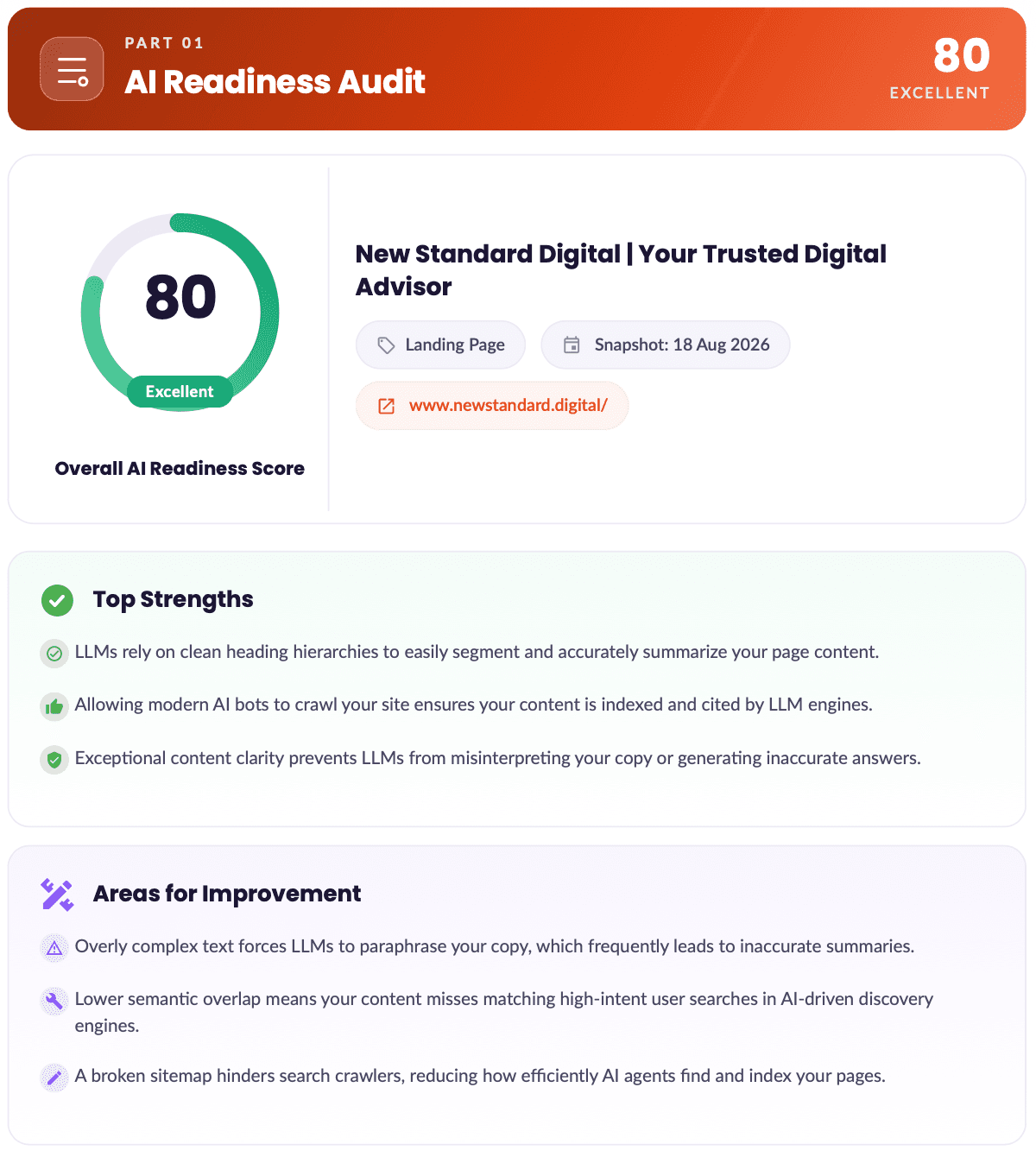
AI Readiness and AI Search Visibility measure different things. A website can be technically well prepared for AI systems and still have little or no visibility in AI-generated answers.
AI Readiness
AI Readiness measures whether your website is structured, accessible, and understandable in ways that help AI systems find and process its content. The overall score is a weighted average of the six report categories below.
AI Search Visibility
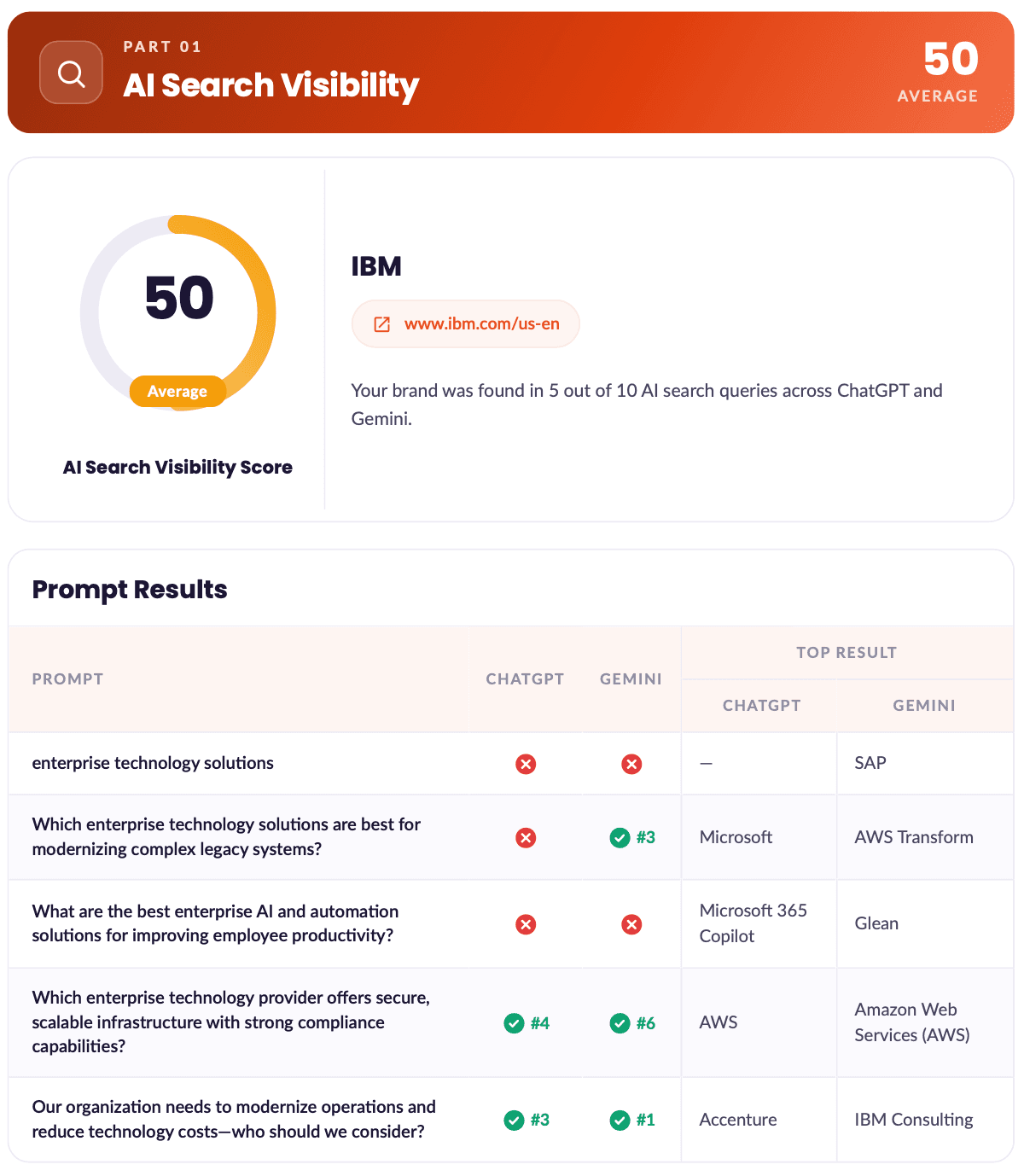
AI Search Visibility measures whether your brand appeared in the report's tested prompts across ChatGPT and Gemini. This is an outcome score, not a technical readiness score.
The sample report shows why that distinction matters: it received 80/100 for AI Readiness but 0/100 for AI Search Visibility.
How to Read the Statuses and Impact Levels
Pass: The check met the report's target.
Partial Pass: Some expected signals are present, but there are still gaps.
Fail: The check missed the target and should be reviewed.
Skipped: The test could not be completed. Read the note before treating this as a website problem.
Impact labels tell you how much attention a finding deserves. Start with High Impact issues, then Medium Impact issues, and leave Low Impact cleanup until the larger problems are handled.
Structured Data
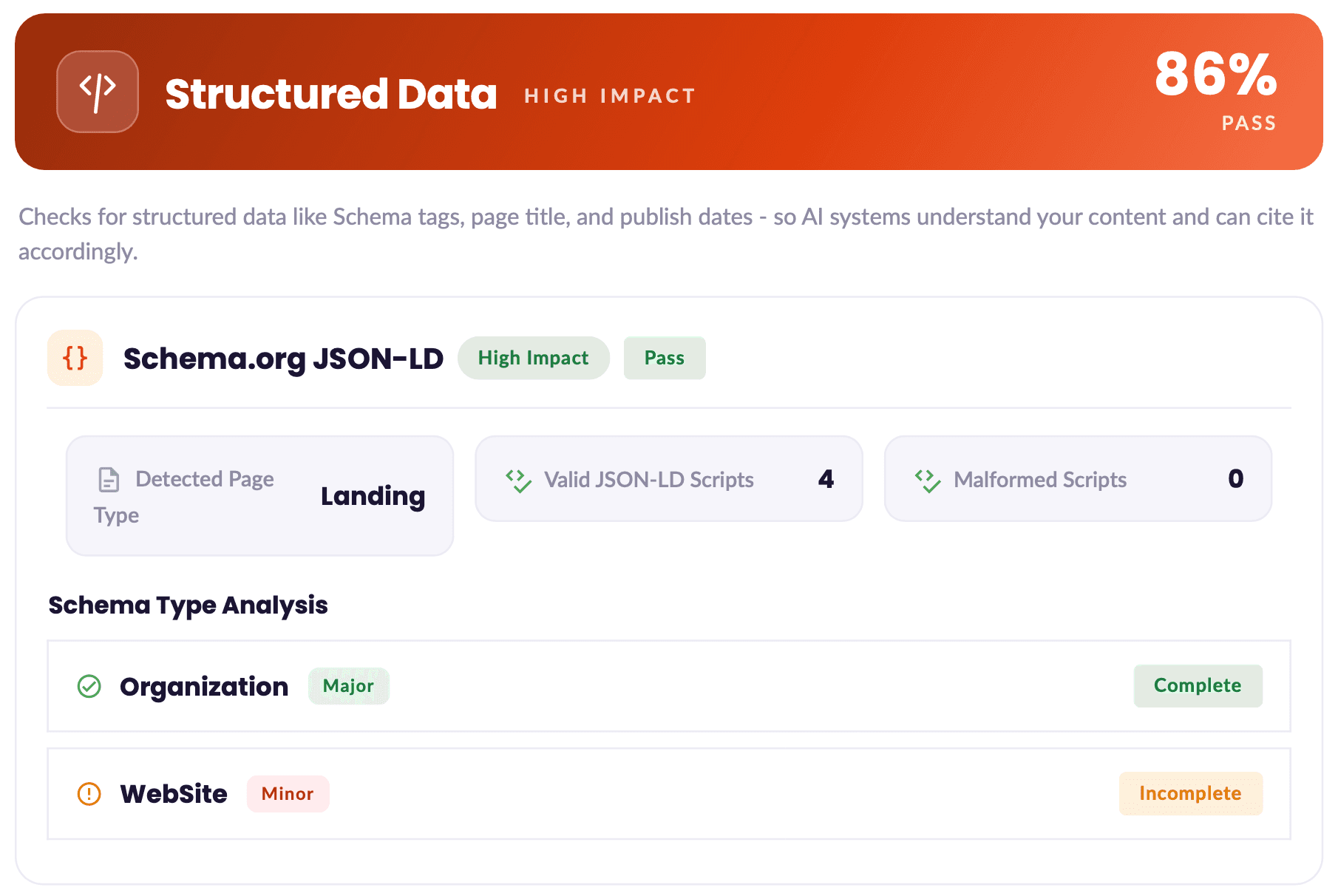
Structured Data checks whether the page gives machines clear context through Schema.org JSON-LD, page type, titles and descriptions, entity links, and media labels.
Why it matters
Clear, accurate machine-readable information helps AI systems identify what the page and business are about and cite them accordingly.
What to look for
Schema problems: Malformed JSON-LD or incomplete schema types.
Weak metadata: Titles and descriptions that are vague or do not describe the page's actual focus.
Entity problems: Missing or dead sameAs links.
Media problems: Images without useful alt text.
A high score can still hide an important messaging problem. In the sample, the schema passes, but the title and description are rated poor because they are too generic.
LLM-Friendly Formatting
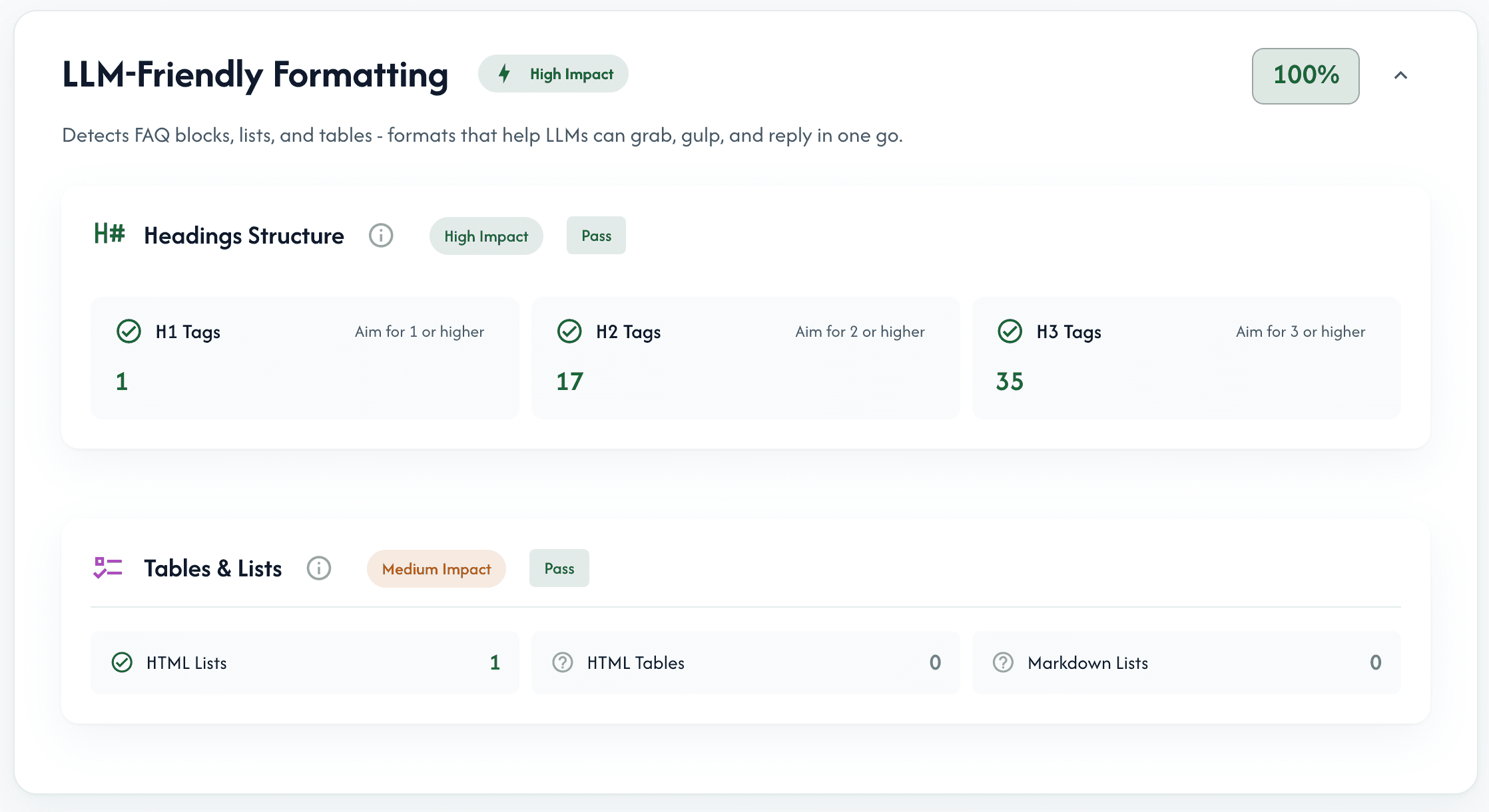
LLM-Friendly Formatting checks whether the page is organized with headings, lists, and tables. These formats make information easier for AI systems to identify and extract.
What to look for
Heading structure: A clear H1, H2, and H3 hierarchy.
Scannability: Important information broken into useful sections instead of long blocks of text.
Lists and tables: Steps, comparisons, and grouped information presented in the clearest format.
The report counts headings, HTML lists, HTML tables, and Markdown lists. Use this as a structure check, not a reason to add unnecessary formatting.
Accessibility
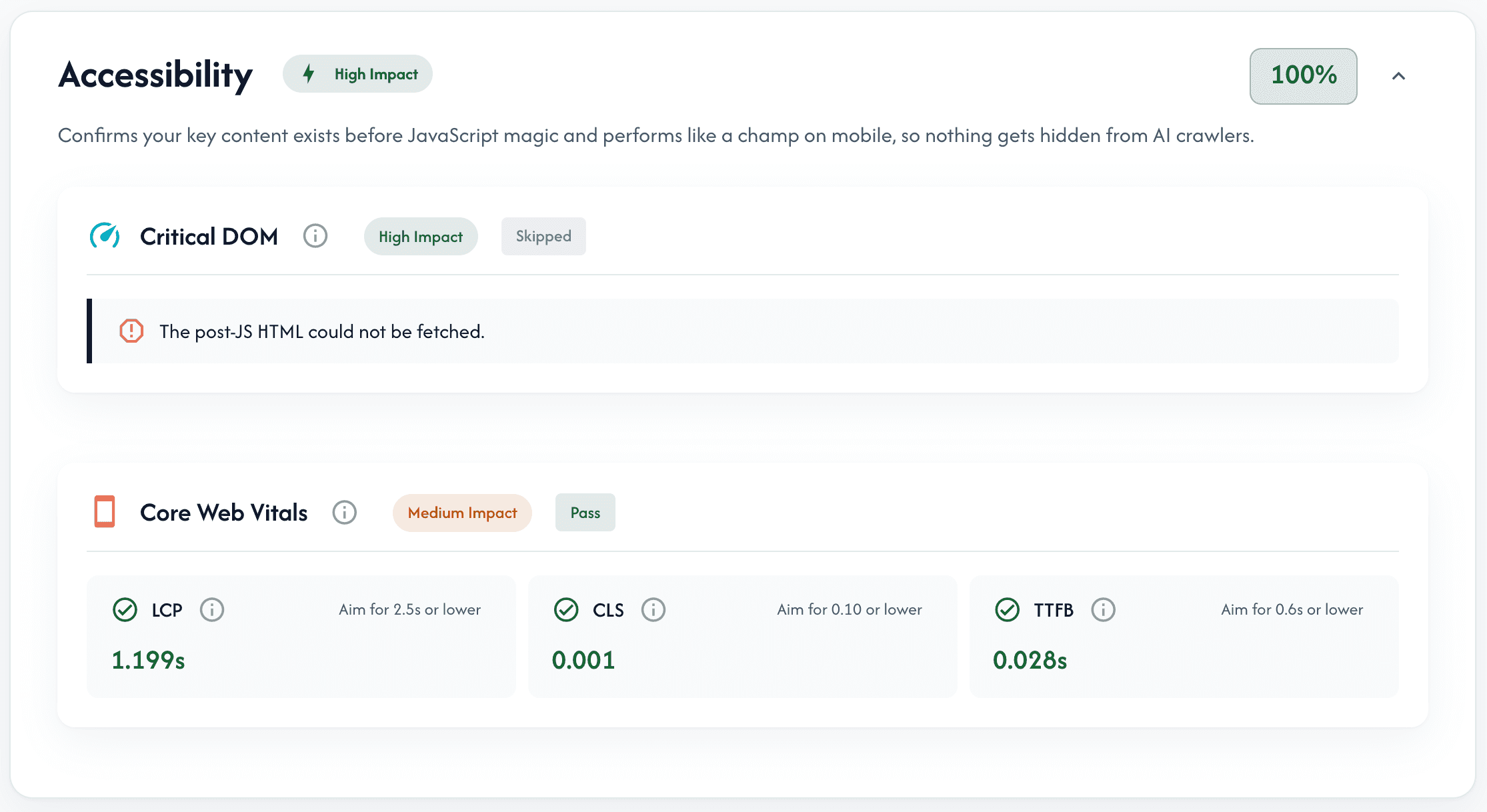
In this report, Accessibility is about whether AI crawlers can retrieve the important page content and whether the page performs well on mobile.
What to look for
Critical DOM: Whether important content is available before or after JavaScript processing.
Largest Contentful Paint (LCP): How quickly the main content loads.
Cumulative Layout Shift (CLS): How stable the page layout is while loading.
Time to First Byte (TTFB): How quickly the server begins responding.
If Critical DOM is marked Skipped, read the note. In the sample, post-JavaScript HTML could not be fetched, while the performance checks still passed.
LLM as a Judge
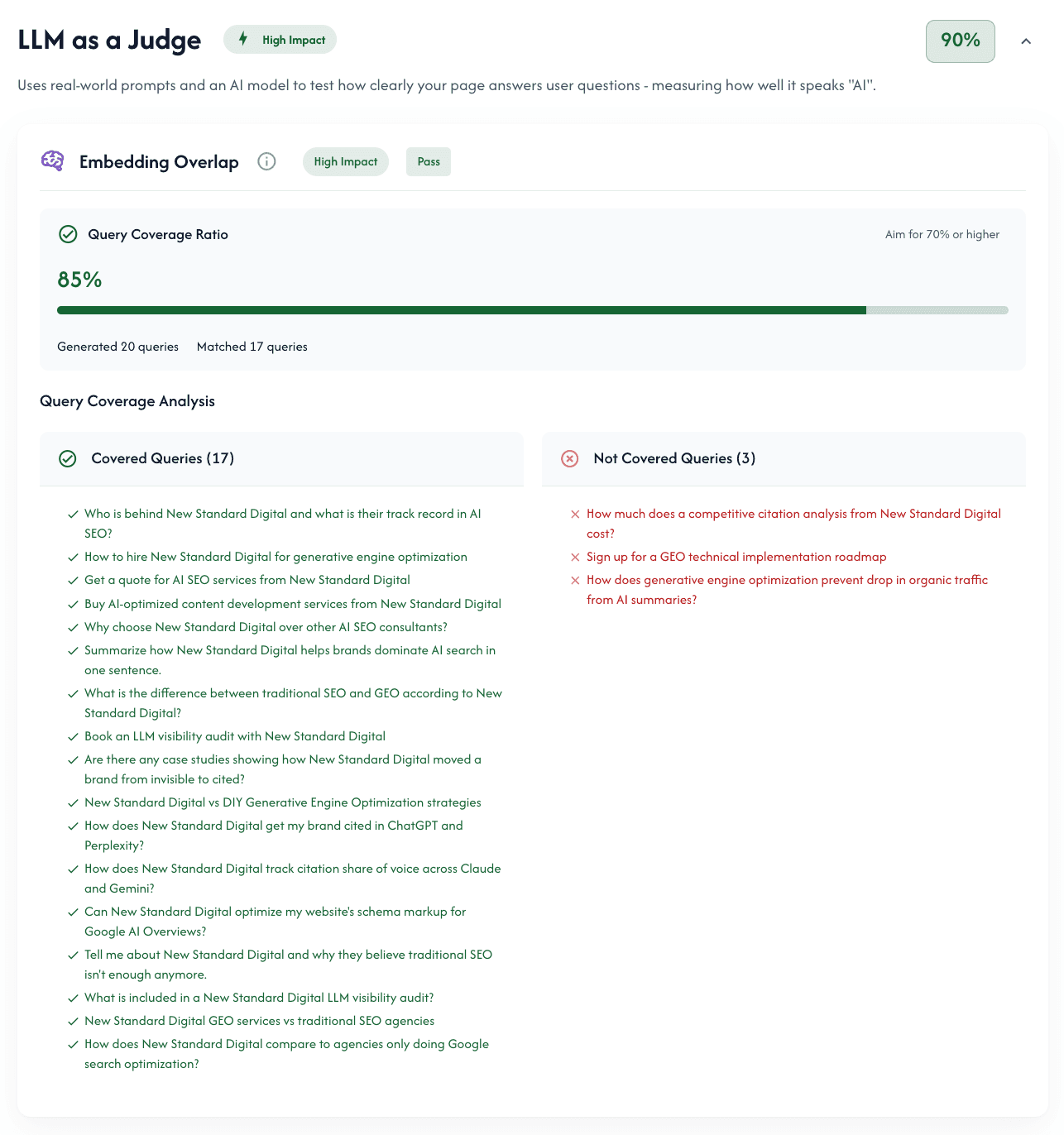
LLM as a Judge asks a practical question: Does this page clearly answer the kinds of questions a potential customer may ask?
Embedding Overlap
The report generates relevant queries and measures how many the page covers. Review both Covered Queries and Not Covered Queries. The missed queries point to potential content gaps.
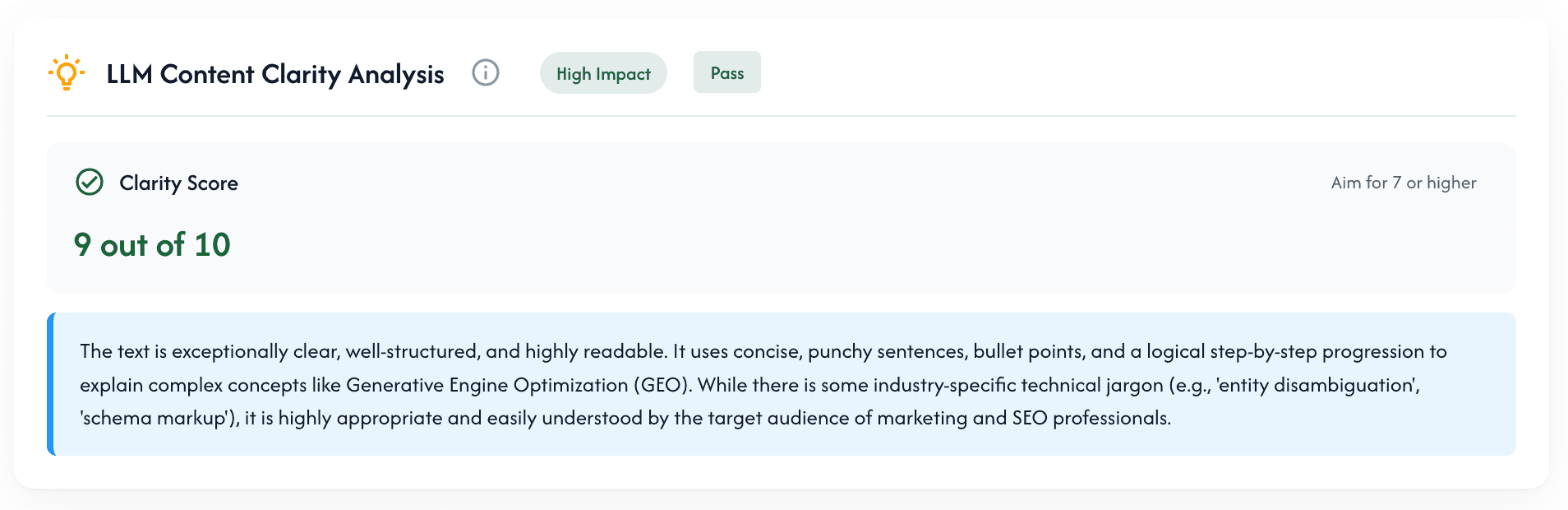
LLM Content Clarity
An AI model separately scores how clear and well structured the copy is. The sample scored 9/10 for clarity even though its Readability score was low. These checks measure different things.
Do not chase the percentage alone. Use the uncovered queries to decide which useful topics, proof points, service details, or customer questions deserve clearer answers.
Discoverability
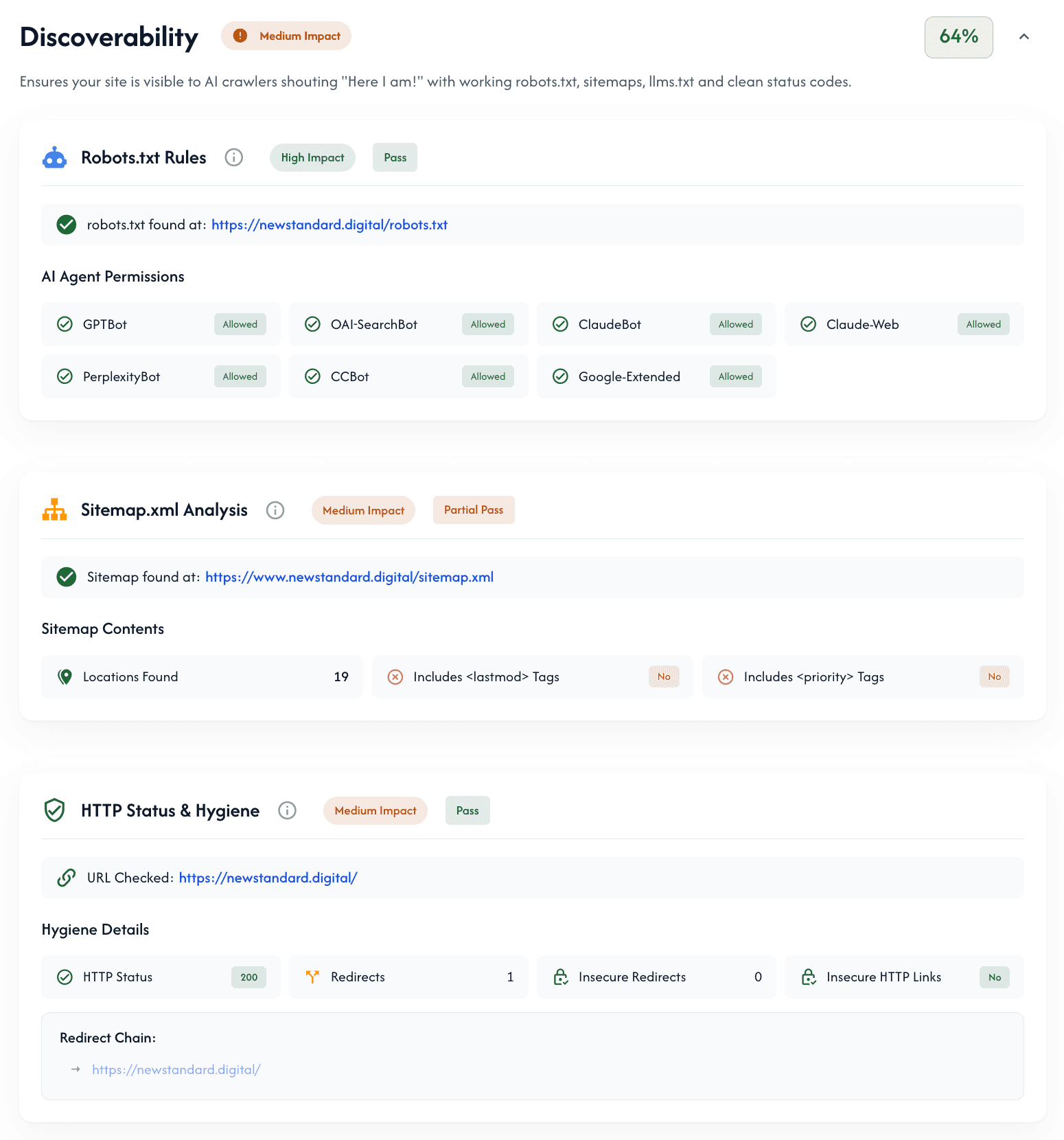
Discoverability checks whether AI crawlers are allowed to access the site and whether the site gives them clean paths to important pages.
Start with the important checks
Robots.txt Rules and AI Agent Permissions: Whether crawlers such as GPTBot, OAI-SearchBot, ClaudeBot, PerplexityBot, CCBot, and Google-Extended are allowed.
Sitemap.xml Analysis: Whether the sitemap exists and includes useful URL information.
HTTP Status & Hygiene: Whether the page returns a working status code without bad redirects or insecure links.
Then review the lower-impact checks
Open Graph Tags
Twitter Card Tags
LLMs.txt Analysis
MCP.json Check
The sample report labels these items Low Impact. Address them after the larger crawl, content, and discovery problems unless one reveals an obvious defect.
Readability
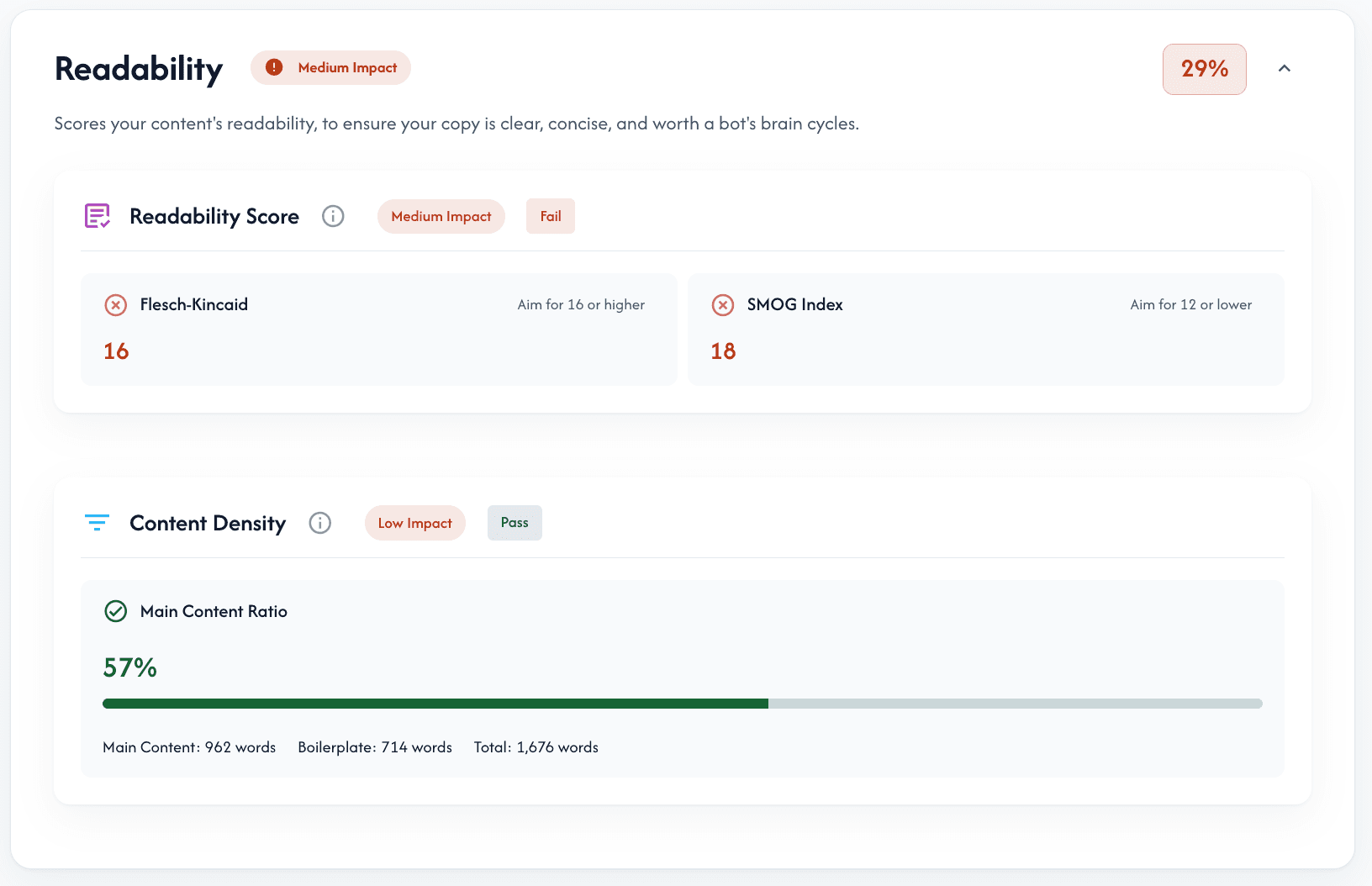
Readability measures sentence and language complexity, plus how much of the page is main content instead of navigation, footer content, and other boilerplate.
Readability Score
Compare the Flesch-Kincaid and SMOG results with the report's targets. A fail means the copy may be harder to process than intended.
Content Density
The Main Content Ratio compares useful page content with boilerplate. A page with too much repeated or secondary material can dilute the useful information available to a crawler.
Readability and LLM Content Clarity are separate. If readability is weak but clarity is strong, simplify dense sentences and jargon without removing useful detail.
AI Search Visibility Overview
AI Search Visibility is the outcome section. It shows whether the brand appeared in the report's tested prompts across ChatGPT and Gemini.
Prompt Results
Each row represents a tested prompt. The ChatGPT and Gemini columns show whether your brand was found. Top Result shows which brand led the response when yours did not.
Look for patterns: Which questions exclude you? Do ChatGPT and Gemini return different brands? Which competitors appear repeatedly? Treat the results as the dated snapshot shown on the report, not a permanent result.
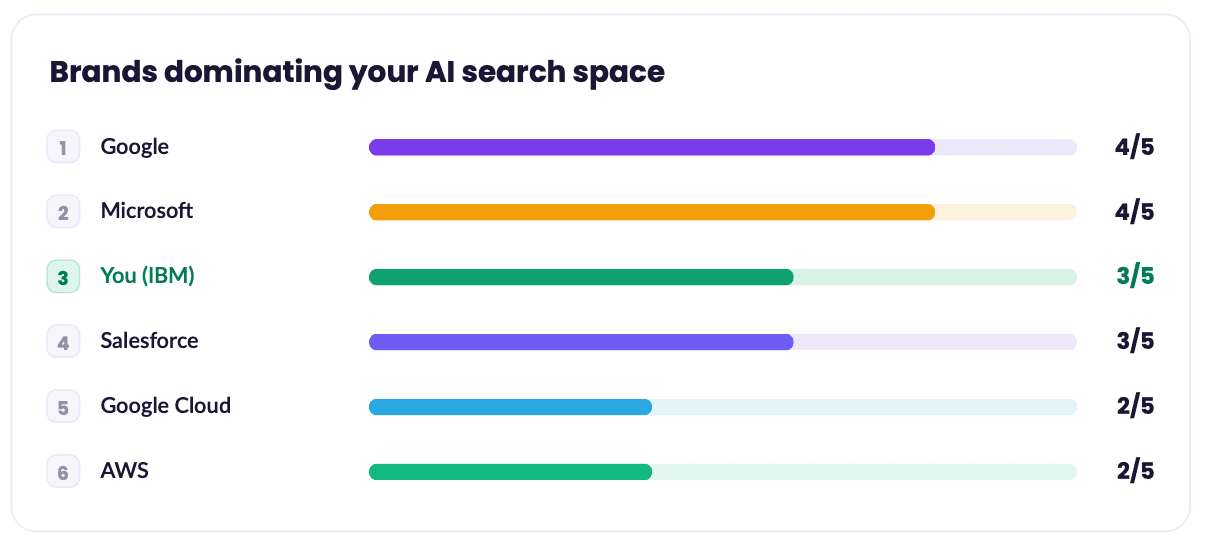
Brands Dominating Your AI Search Space
This section combines the tested results into a competitor view. It shows which brands and sources AI systems associated most often with the topic in the sample.
These competitors may not be the same companies you see beside you in traditional Google results. Use the list to understand which brands AI systems currently connect with the questions you want to own.
What Should You Fix First?
High Impact failures and partial passes. Start with the items that carry the most weight.
Access and discovery problems. Fix anything that prevents important content from being retrieved or found.
Uncovered customer questions. Use Not Covered Queries to plan clearer, more useful content.
Structured Data and message clarity. Make sure schema, titles, descriptions, and entity signals accurately describe the page.
Medium Impact improvements. Address readability, sitemaps, and other meaningful gaps.
Low Impact checks. Clean these up after the larger issues unless one reveals an obvious defect.
Your Report Is a Starting Point
The audit gives you a snapshot of your technical readiness, content gaps, and current visibility across a defined set of AI search prompts. Improving performance usually requires a combination of technical cleanup, clearer content, stronger entity signals, and ongoing measurement.
Want Help Improving Your AI Visibility?
New Standard Digital can help you interpret the findings, choose the highest-value fixes, and build a practical AI SEO and GEO strategy.
Book A Free Strategy Call With Alex (Our Founder) Today
Frequently Asked Questions
What is an AI Readiness Score?
Your AI Readiness Score measures how well your website is prepared for AI systems to access, understand, and use its content. It combines the results from Structured Data, LLM-Friendly Formatting, Accessibility, LLM as a Judge, Discoverability, and Readability.
What is an AI Search Visibility Score?
Your AI Search Visibility Score measures whether your brand appeared in the report’s tested searches across ChatGPT and Gemini. It is separate from AI Readiness because a technically optimized website may still not appear in AI-generated answers.
Can a website have high AI Readiness but low AI Search Visibility?
Yes. A website may be technically accessible and well structured without having enough content coverage, authority, or brand recognition to appear in AI search results. The sample report demonstrates this with an AI Readiness Score of 80/100 and an AI Search Visibility Score of 0/100.
What should I fix first in my AI SEO audit?
Start with High Impact failures and partial passes. Prioritize anything preventing AI crawlers from accessing your content, followed by uncovered customer questions, structured data problems, and unclear page titles or descriptions.
What does “LLM as a Judge” mean?
LLM as a Judge evaluates whether your webpage clearly answers the kinds of questions potential customers may ask. It measures query coverage and separately scores how clear and well structured the content is.
Why does AI crawler accessibility matter?
AI systems cannot reliably understand, reference, or cite content they cannot retrieve. Robots.txt rules, JavaScript rendering, page performance, HTTP status codes, and sitemaps can all affect whether AI crawlers can access and discover your pages.
What are “Not Covered Queries”?
Not Covered Queries are relevant questions generated during the audit that the webpage does not adequately answer. They can be used to identify missing topics and plan new content or improvements to the existing page.
How often should I run an AI Search Visibility audit?
Run another audit after making significant technical or content changes. You should also review visibility periodically because answers from ChatGPT, Gemini, and other AI platforms can change as their systems, sources, and understanding of your brand evolve.